2G is the second generation telecommunications technology standard for broadband cellular networks, succeeding early analog systems retroactively known as 1G. 2G cellular networks were commercially launched on the GSM standard in Finland by Radiolinja (now part of Elisa Oyj) in 1991.[1]
Features
Three primary benefits of 2G networks over their predecessors were:
- Digitally encrypted phone conversations, at least between the mobile phone and the cellular base station but not necessarily in the rest of the network.
- Significantly more efficient use of the radio frequency spectrum enabling more users per frequency band.
- Data services for mobile, starting with SMS text messages. Evolving 2G technologies later enabled various networks to provide picture messages, and MMS (multimedia messages).
History
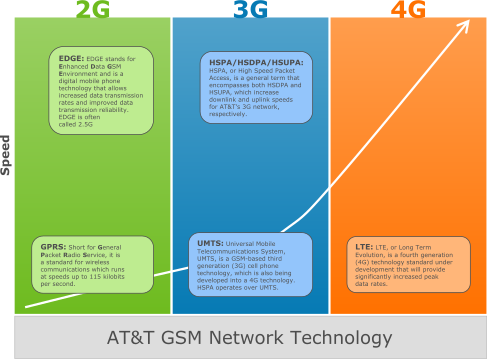
After 2G was launched, the previous mobile wireless network systems were retroactively dubbed 1G. While radio signals on 1G networks are analog, radio signals on 2G networks are digital. Both systems use digital signaling to connect the radio towers (which listen to the devices) to the rest of the mobile system.
With General Packet Radio Service (GPRS), 2G offers a theoretical maximum transfer speed of 40 kbit/s.[2] With EDGE (Enhanced Data Rates for GSM Evolution), there is a theoretical maximum transfer speed of 384 kbit/s.[2]
The most common 2G technology was the time division multiple access (TDMA)-based GSM, originally from Europe but used in most of the world outside Japan and North America. In North America, Digital AMPS (IS-54 and IS-136) and cdmaOne (IS-95) were the main systems. In Japan, the ubiquitously deployed system was Personal Digital Cellular (PDC).
Evolution
- 2.5G (GPRS) is used to describe 2G-systems that have implemented a packet-switched domain in addition to the circuit-switched domain. It doesn't necessarily provide faster service because bundling of timeslots is used for circuit-switched data services (HSCSD) as well.[3]
- 2.75G (EDGE) is used to describe GPRS networks that evolved with the introduction of 8PSK encoding. While the symbol rate remained the same at 270.833 samples per second, each symbol carried three bits instead of one. Enhanced Data rates for GSM Evolution (EDGE), Enhanced GPRS (EGPRS), or IMT Single Carrier (IMT-SC) is a backward-compatible digital mobile phone technology that allows improved data transmission rates, as an extension on top of standard GSM. EDGE was deployed on GSM networks beginning in 2003, initially by AT&T in the United States. The original iPhone was launched in June 2007 using the EDGE standard. However, two days after the launch, AT&T's EDGE network went down, though AT&T denied that iPhone traffic was the cause.[4]
References
- ↑ Radiolinja's History (20 April 2004).
- ↑ 2.0 2.1 GPRS & EDGE.
- ↑ What is Second and a Half Generation (2.5G) | IGI Global.
- ↑ Two days after iPhone launch, AT&T EDGE goes down by Nancy Gohring, Macworld. 2007-07-02.
External links
- What is the difference between 3G, 4G and 5G? at Verizon (2019-11-18)
- 2G at Wikipedia