BASIC (Beginner's All-purpose Symbolic Instruction Code) is a simple language originally designed for ease of programming by students and beginners. Many dialects exist, and BASIC was popular on early computers with sound and graphics support. Most microcomputers versions were interactive and interpreted.[1]
History
Early BASIC dialects had no graphic operations except with graphic characters. In the 1970s BASIC interpreters became standard features in mainframes and minicomputers. Some versions included matrix operations as language primitives.
Originally, all references to code, such as GOTO and GOSUB (a subroutine call), referred to the destination by its line number. This allowed for very simple editing in the days before text editors were considered essential. Just entering the line number alone would delete the existing line and typing a new line with the same number would replace the existing line of code. Programs were typically numbered in steps of ten to allow for insertions. Later versions, such as BASIC V, allowed GOTO-less structured programming with named procedures and functions, IF-THEN-ELSE-ENDIF constructs and WHILE loops etc.[1]
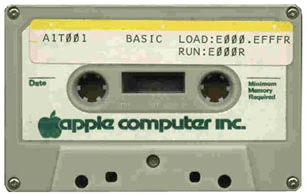
A cassette tape containing Apple BASIC for the Apple I computer
BASIC dialects developed at Apple
- Integer BASIC, also known as Apple BASIC, the first interpreter for the Apple I created by Steve Wozniak.
- Applesoft BASIC, co-developed with Microsoft to add floating-point instructions for the Apple II series.
- MacBASIC, internally developed by Apple Computer before it was acquired by Microsoft and then shelved.
Criticism
BASIC, and other early languages like Pascal, were blamed for encouraging poor programming practices among "proto-hackers", as it had been designed as an educational tool, but unexpectedly became widely adopted on low-end microcomputers through happenstance. A novice can quickly learn to write short BASIC programs (on the order of 10-20 lines). However, writing longer programs becomes unweildy and encourages bad coding habits that make it harder to use more powerful languages.[1]
References
- ↑ 1.0 1.1 1.2 BASIC at the Free On-Line Dictionary Of Computing. 1995-03-15.
External links
- Objective-Basic for Xcode official website
- BASIC at Wikipedia