Integrated Services Digital Network (ISDN) is a set of communications standards allowing a single wire or optical fiber to carry voice, digital network services and video. ISDN was intended to replace legacy telephone systems.[1] It has since been superseded by other broadband protocols, such as digital subscriber lines (DSL).[2]
History
ISDN was first published as one of the 1984 ITU-T "Red Book" recommendations. The 1988 "Blue Book" recommendations added many new features. ISDN uses mostly existing public switched telephone network (PSTN) switches and wiring, upgraded so that the basic "call" is a 64 kilobits per second, all-digital end-to-end channel. Packet and frame modes are also provided in some places.
Deployment
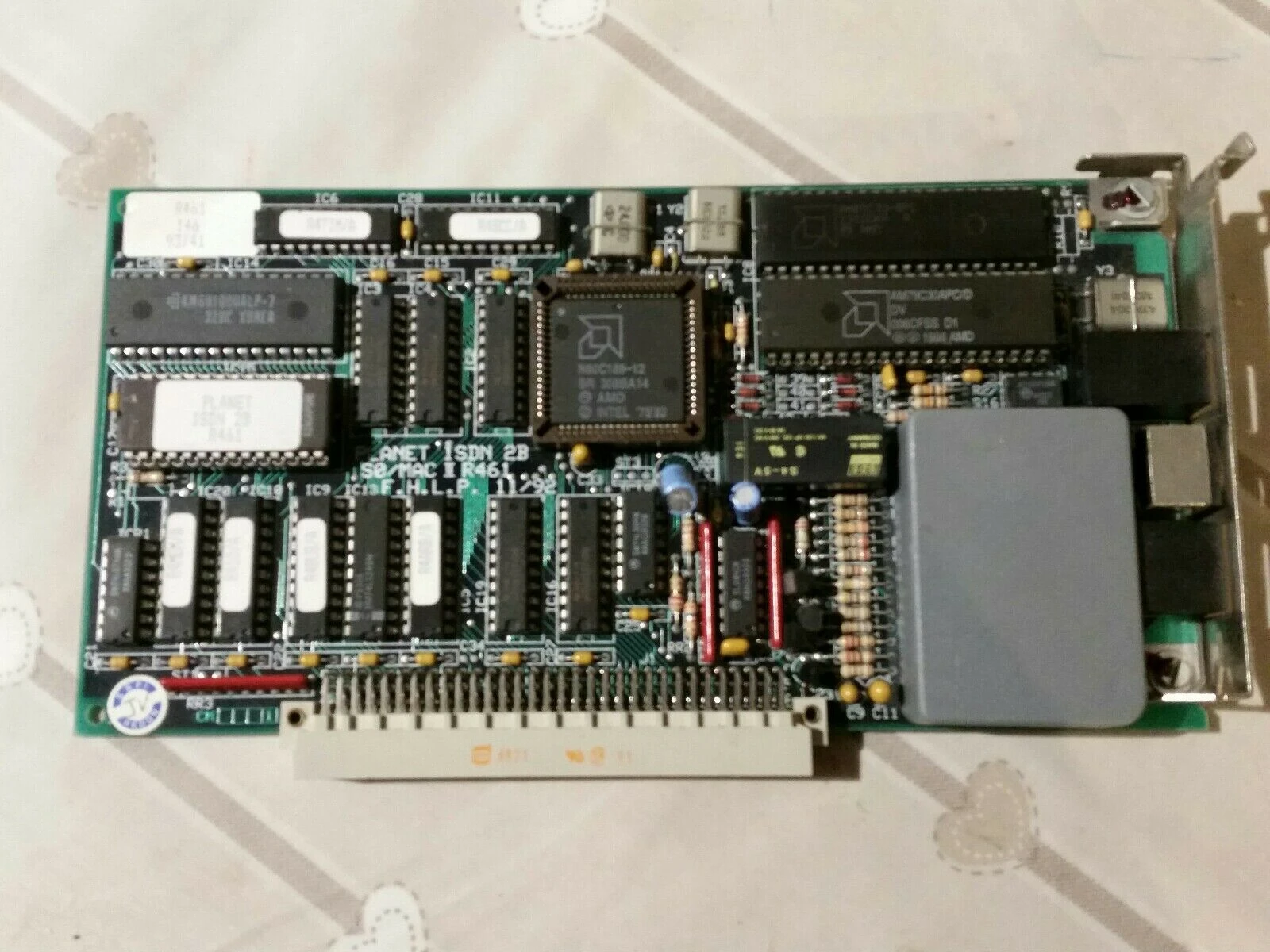
Apple's first ISDN card was introduced in 1991 for Macintosh II models with NuBus slots. The Apple ISDN NB Card contained its own Motorola 68000 processor, 512KB of memory, and cost $1,100. It was compatible with AT&T's 5ESS and Northern Telecom's DMS-100 telephone exchanges.[3] However, it was discontinued in the following year due to low adoption.[4] SAT/SAGEM later released a Planet ISDN NuBus card, but at a list price of $2.995.[5] In 1996, Farallon introduced its Netopia ISDN Modem as an external device at far lower prices.[6]
ISDN was offered by local telephone companies in Australia, France, Japan and Singapore, with limited availability in areas of the United Kingdom and United States. In March 1994, ISDN was deployed in Germany under a specification called 1.TR.6. France Telecom launched Numeris, which used a non-standard protocol called VN4 (the 4th version), though with high pricing. Belgium launched a V1 experimental system. The European nations worked to unify these standards under Euro-ISDN.[1]
Specifications
There are different kinds of ISDN connections of varying bandwidth (see DS level):
       DS0  =    1 channel  PCM at   0.064 Mbps
T1  or DS1  =   24 channels PCM at   1.54  Mbps
T1C or DS1C =   48 channels PCM at   3.15  Mbps
T2  or DS2  =   96 channels PCM at   6.31  Mbps
T3  or DS3  =  672 channels PCM at  44.736 Mbps
T4  or DS4  = 4032 channels PCM at 274.1   Mbps
Each channel is equivalent to one voice channel, with DS0 as the lowest level of the circuit. However, 64 kbps was never referred to as "T0". T1C, T2 and T4 were less commonly used, except for T2 over microwave links.
A Basic Rate Interface (BRI) is two 64K "bearer" channels and a single "delta" channel ("2B+D"). A Primary Rate Interface (PRI) in North America and Japan consists of 24 channels, usually 23 B + 1 D channel with the same physical interface as T1. Elsewhere, the PRI usually has 30 B + 1 D channel and an E1 interface. A terminal adapter (TA) can be used to connect ISDN channels to existing interfaces such as EIA-232 and V.35.
Different services may be requested by specifying different values in the "Bearer Capability" field in the call setup message. One ISDN service is "telephony" (i.e. voice), which can be provided using less than the full 64 kbps bandwidth (64 kbps would provide for 8192 eight-bit samples per second) but will require the same special processing or bit manipulation as ordinary PSTN calls. Data calls have a Bearer Capability of "64 kbps unrestricted".[1]
References
- ↑ 1.0 1.1 1.2 Integrated Services Digital Network at the Free On-Line Dictionary Of Computing. 1998-03-29.
- ↑ Digital Subscriber Line at the Free On-Line Dictionary Of Computing. 2001-04-30.
- ↑ Apple offers ISDN board for NuBus Macintoshes by Computer Business Review, Tech Monitor. 1991-10-20.
- ↑ More Apple News by Adam Engst, TidBITS. 1992-09-14.
- ↑ What is a Mac PLanet? by Stuart Brainer, Very Computer. 1995-07-15.
- ↑ Farallon simplifies ISDN connections, CNET. 1996-03-25.
External links
- ISDN by Scott L. Barber at Low End Mac (1998-04-25)
- Integrated Services Digital Network at Wikipedia