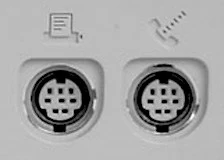
Serial ports on a classic Mac
A serial port (or comm port) is a connector on a computer to which a serial line can be attached to communicate with peripherals that communicate through a serial (bit-stream) protocol. The most common type of serial port is a 25-pin D-type connector (DB-25) carrying EIA-232 signals (also known as RS-232). Smaller connectors (e.g. 9-pin D-type) carrying a subset of EIA-232 are often used on personal computers. The serial port is usually connected to an integrated circuit called a UART which handles the conversion between serial and parallel data.[1]
History
In the days before bit-mapped displays, and today on multi-user systems, the serial port was used to connect one or more terminals (teletypewriters or VDUs), printers, modems and other serial peripherals. Two computers connected together via their serial ports, possibly via modems, can communicate using a protocol such as UUCP, CU, SLIP.[1]
Apple II serial cards
Apple produced three serial cards for the Apple II series of computers:[2]
- Apple II Communications Card, released in April 1978 to connect modems.
- Apple II Serial Interface Card, released in August 1978 to connect serial printers.
- Apple II Super Serial Card, released in 1981 to connect either of the above.
The Apple IIc was introduced in 1984 with built-in DIN-5 modem and printer serial ports.
Serial ports in Macs
The early Macintosh 128K through 512Ke models featured built-in DE-9 serial ports. Starting with the Macintosh Plus in 1986, most Macs from the "beige" era used a Mini DIN-8 port that carried RS-422 signals, an updated superset of RS-232.[3]
Replacement
Apple replaced the Mini DIN-8 serial ports with a backwards-compatible Mini DIN-9 GeoPort in the Quadra AV and "beige" Power Macintosh series. Starting with the first iMac G3 in 1998, Apple replaced classic serial ports with variations of the Universal Serial Port (USB).[3]
References
- ↑ 1.0 1.1 Serial port at the Free On-Line Dictionary Of Computing. 1995-01-02. Accessed 2021-03-21.
- ↑ 13-Peripherals: Interface cards by Steven Weyhrich, Apple II History. Accessed 2021-03-18.
- ↑ 3.0 3.1 One cable to rule them all: a look at Apple's retired connectors through the years by Stephen Silver, AppleInsider. 2018-07-04.
External links
- Identify the ports on your Mac at Apple Support (2020-11-17)
- Classic Mac Ports by Ray White at The White Files (2004)
- Serial port and Apple II serial cards at Wikipedia
Articles
- Macintosh Serial Throughput by Daniel Knight at Low End Mac (1998-04-12)