|
|---|

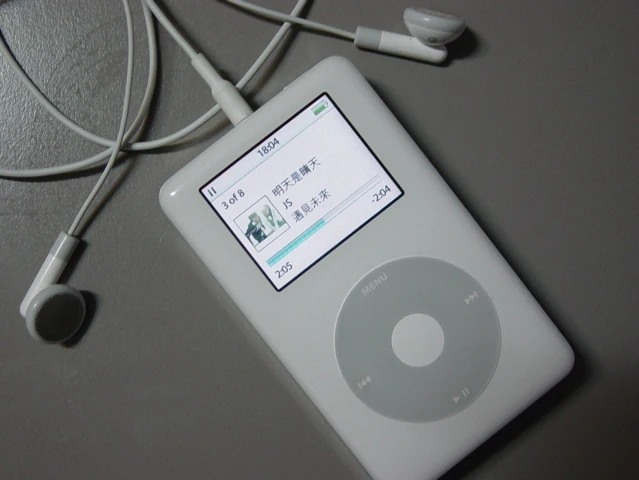
iPod photo
The iPod Photo was announced on October 26, 2004, and in November 2004 named iPod photo, with the second word no longer capitalized, apparently to bring it in line with the naming scheme of the iPod mini.
On June 28, 2005, it was renamed the iPod with color display and merged with the fourth generation iPods. All future iPods would have a color display (except for the iPod mini and the monitorless iPod shuffle).
The iPod photo is a hard drive-based music player nearly identical to the 4G click-wheel iPod. However, unlike earlier models which were monochrome, its 220x176 pixel LCD display is capable of displaying up to 65,536 colors. It also offers hard drives in 40 and 60 GB capacities. These enhancements allow users to store and display photos on the iPod photo.
Models
- iPod photo 30 GB model: February 23, 2005 - June 28, 2005.
- iPod photo 40 GB model: October 26, 2004 - February 23, 2005
- iPod photo 60 GB model: October 26, 2004 - June 28, 2005
On February 23, 2005, a 30 GB version was introduced while the 40 GB version was retired. Along with lowered prices (USD 349 for the 30 GB version, and USD 449 for the 60 GB version), however, also came less accessories; for example, the Dock Connector is now optional instead of being included. Some cables, too, also are no longer part of the package. However, Apple did offer, for USD 29, offer the iPod Camera Connector (available as of March 2005).
Features
Music
The iPod photo can play MP3, WAV, AAC/M4A, Protected AAC, AIFF, Audible audiobook, and Apple Lossless file formats. It cannot play RealAudio files, but the Windows version of iTunes has a feature that can convert unprotected WMA files to acceptable formats.
Photo
The iPod photo supports JPEG, BMP, GIF, TIFF, and PNG graphic file formats, and can be attached to a TV for slideshows. Apple's advertised battery life for continuous music playback is fifteen hours, or five hours for a continuous slideshow with music.
Extras
The iPod photo has additional support for PDA-like functions. By synchronizing it via iSync, contents from the Address Book and iCal can be copied onto the iPod, alarms intact. It can also store text-based notes (even multilingual ones). A sleep timer and an alarm timer is also available, as is a clock.
Four games -- Brick, Music Quiz, Parachute and Solitaire -- are also available on the iPod.
Additional extensible features of the iPod photo include Photo Import and Voice Memos. These, however, require optional third-party accessories.
Synchronization
The iPod photo does all of its music and photo synchronization in iTunes; however, iPhoto version 4.0.3 or a later version is required for photo synchronization, even though the photo sync never requires any controls to be tweaked in iPhoto.
The iPod is synchronized in such a fashion that all the music is synchronized first. Given that there is sufficient space remaining, photo synchronization follows until either the iPod photo is filled to the brim or the entire photo synchronization is completed.
While the photos are prepared for the synchronization, the Mac stores cached versions of the images in the iPod photo Cache folder inside the iPhoto Library folder. This folder alone can get very big. Apple says that this folder can be thrown away after a photo sync.
Versions of iLife, beginning with iLife '05, are fully compatible with the iPod photo.
References
- iPod Photo - Technical Specifications, Apple Computer. Archived 2004-10-27.
See also
External link
- iPod Photo / iPod photo at Apple (archived 2004-10-27 / 2004-11-13)
- iPod photo and with Color Display at Low End Mac (2004-10-26, 2005-06-28)
- iPod photo at Wikipod (archived 2005-02-16)
- iPod Photo at Wikipedia