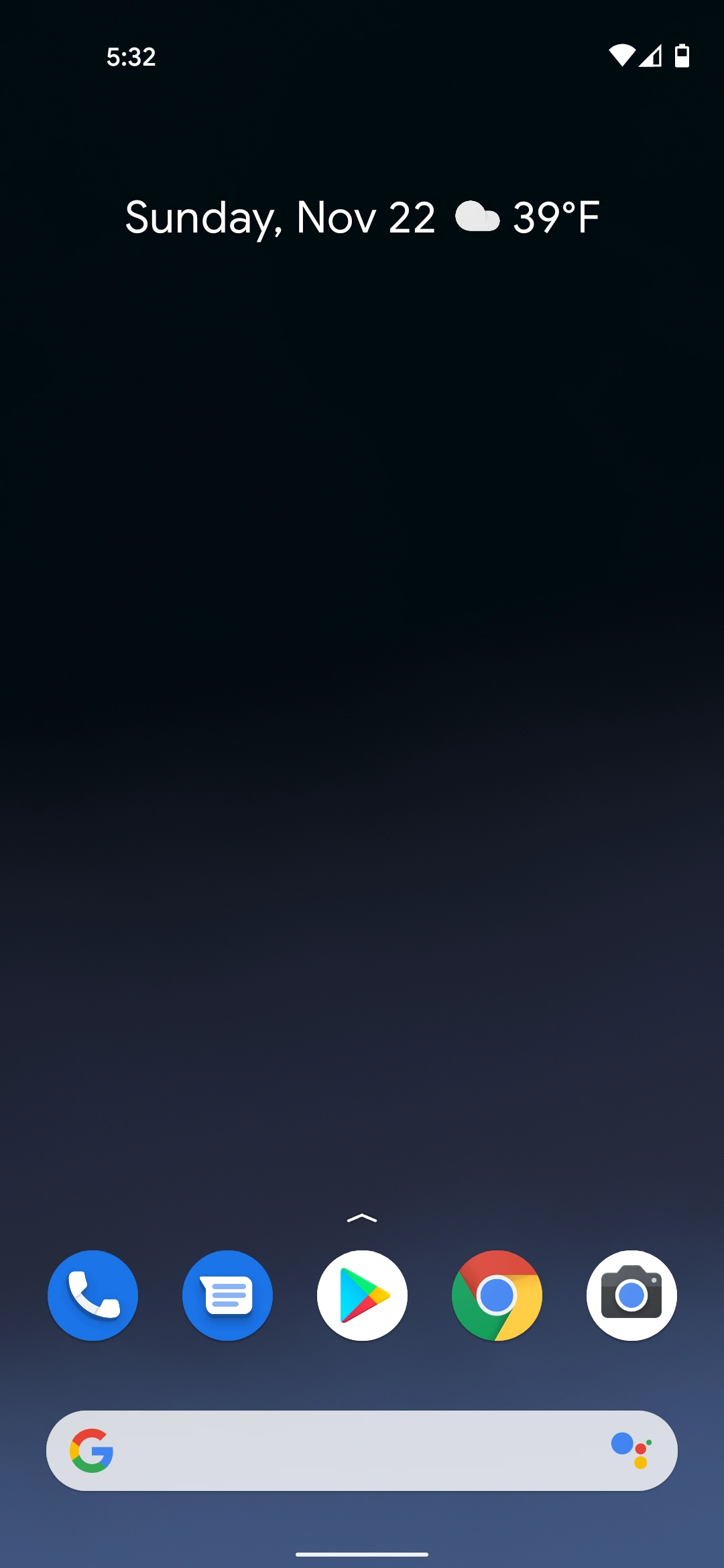
Home screen of Android 11 “Red Velvet Cake” running on Google's Pixel 4a.
Android is free and open source software; its source code is known as Android Open Source Project (AOSP), which is primarily licensed under the Apache License. However most Android devices ship with additional proprietary software pre-installed,[2] most notably Google Mobile Services (GMS)[3] which includes core apps such as Google Chrome, the digital distribution platform Google Play and associated Google Play Services development platform. About 70 percent of Android smartphones run Google's ecosystem;[4] competing Android ecosystems and forks include Fire OS (developed by Amazon) or LineageOS. However the "Android" name and logo are trademarks of Google which impose standards to restrict "uncertified" devices outside their ecosystem to use Android branding.[5][6]
The Android operating system was created at Android Inc., founded in October 2003 at Palo Alto, California. Co-founder Andy Rubin is a former engineer of Apple Computer who was nicknamed "Android" by his former co-workers there due to his interest in robotics.[7] In 2005, Android was acquired by Google for US$50 million. Rubin remained as an executive overseeing Android until he left Google in 2014 following an internal investigation into an alleged sex scandal.[8]
Android has been the best-selling operating system worldwide on smartphones since 2011 and on tablets since 2013. As of May 2017, it had over two billion monthly active users, the largest installed base of any operating system, and as of January 2021, the Google Play Store featured over 3 million apps.[9] Android users can install apps from unofficial sources on the open Internet through a process known as sideloading — doing the same on an iOS device would require jailbreaking. Apple CEO Tim Cook states that such security measures are in place to reduce malware attacks and protect user privacy. Cook has openly recommended Android for users who want to sideload apps.[10]
Android 16 (Released date to be determined) (2025)
Note: Android 1.x and versions 10 and up are not publicly referred to by their respective codenames; they are only used internally by staff and some enthusiasts. The dessert names were removed due to marketing considerations as users in some regions around the world may not know what the desserts are.[11]
Migrating between Android and iOS
In 2015, Apple introduced Move to iOS to facilitate the migration of user data from their Android phone to iOS. Over six years later in April 2022, Google introduced its own counterpart, Switch To Android.[18]
The Project Sandcastle team managed to partially port Android 6.0 (Marshmallow) to 10 (Queen Cake) to some jailbrokenApple A10 devices, such as the iPhone 7 and 7th-generation iPod touch.[23] It is bootable, but is in beta, does not yet support the GPU, and is set to read-only as APFS support is unfinished. It is not yet usable on other devices.[24]
Android on Apple TV (1st generation)
A YouTuber managed to install Android 2.2 (Froyo) on a Pentium M-based 1st-generation Apple TV. Android 4.0.4 (Ice Cream Sandwich) could also be installed, but with visual display issues of the color graphics.[25]
A unmodified version of Android 6.0 (Marshmallow) can be installed on a white 2009 MacBook, but it is only partly stable after booting and apps will tend to crash.[26] Another Youtuber managed to boot CyanogenMod 13, a distro of Android 6.1.3, on a 2008 MacBook model. However, the user interface will boot up sideways by default and will require some work to turn it back to normal orientation.[27]
Nearly all iPhone clones and knockoffs run some form of Android that has been modified to simulate iOS with varying degrees of accuracy. Some older ones may be running other firmware.[29][30][31][32][33][34] Most of them have unusual apps preinstalled on the home screen such as the Google Play store. Only Android phones have Google Play store, and seeing it on an iPhone is an obvious giveaway that the iPhone is fake. Many of the knockoff iPhones mimic the superficial appearance of the iOS user interface fairly closely. Some even manage to simulate some iOS-specific features such as the Weather app, Control Center, and even the setup screen.[35] All counterfeit iPhones and other Android smartphones lies about the specifications to market these phones on sites like Wish, or AliExpress. [36][37]
Gallery
Android 4.4.2 "KitKat" on a Jadoo 4 media streaming console.
↑Android – Google Mobile Services(en-US). Android. Retrieved on October 21, 2018. “While the Android Open Source Project (AOSP) provides common, device-level functionalities such as email and calling, GMS is not part of AOSP. GMS is only available through a license with Google [..] We ask GMS partners to pass a simple compatibility test and adhere to our compatibility requirements for their Android devices.”


_iOS_Launcher_Home_Screen_Queen.png "Moto e (2020) iOS Launcher Home Screen Queen.png (1.48 MB)")